Arundel
Arundel sits in the Arun Valley on the western edge of the South Downs National Park, roughly halfway between Chichester and Worthing.
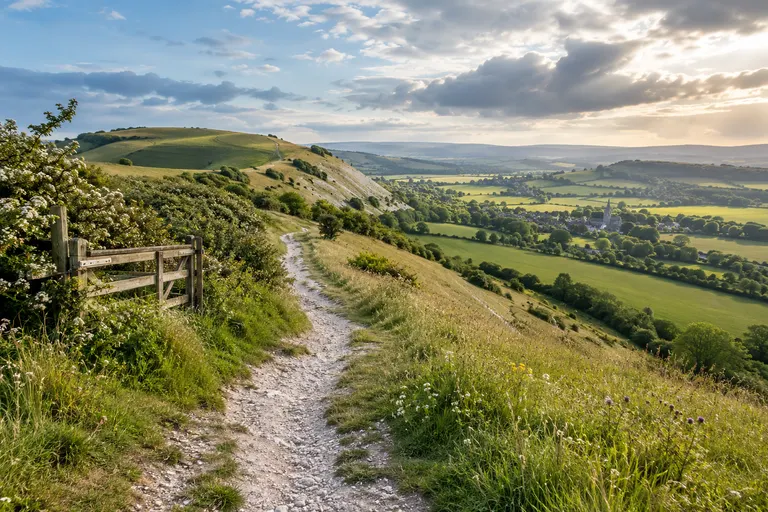
Arundel sits in the Arun Valley on the western edge of the South Downs National Park, roughly halfway between Chichester and Worthing. The town is dominated by two landmarks that define its profile: the Norman castle at the top of the hill and the Catholic cathedral on the valley floor. For many visitors, the reason to come is the castle, but the town’s real strength is how much of West Sussex’s landscape converges here. Downland, river, wetland and coast are all within a short walk or drive.
The Castle and Cathedral
Arundel Castle sits on a natural chalk spur above the River Arun, and its profile of towers, battlements and the tall keep is visible from the station approach and from the South Downs escarpment to the north. The castle is a Norman foundation, though much of what you see today is a 19th-century restoration. It opens seasonally, and the gardens, keep and chapel are the core of the visit. The private chapel and the castle’s extensive grounds are usually open from spring to autumn; check the official Arundel Castle website for the exact calendar before travelling.
The cathedral is the other half of the composition. Officially the Cathedral Church of Our Lady and St Philip Howard, it was founded in the 13th century as a parish church and elevated to cathedral status in 1965. Its Catholic identity is unusual for an English cathedral. The building sits close to the castle, so the two landmarks read as one from the river and the Downs. Visitors should check the cathedral’s own site for service times, tower tours and seasonal events; opening can change around services and private functions.
The castle in detail
Arundel Castle is the seat of the Duke of Norfolk, Earl Marshal of England, and much of the site is a private residence. The motte-and-bailey castle dates from the Norman period, with the earliest parts from the late 11th century. The keep is the oldest surviving feature. The keep and curtain walls are visible from the town’s streets, and the grounds include the Barons’ Hall, the private apartments and the extensive gardens. The castle’s gardens, known as the Collector Earl’s Garden, were created in the early 21st century and include a water feature and a mound with a view over the town. The Fitzalan Chapel is a Grade I listed building, separate from the main admission. The castle is owned by the Duke of Norfolk’s family trust and managed by Arundel Castle Trustees Ltd. Access is limited to the areas shown on the visitor route. Opening dates and ticket prices change annually; check the official Arundel Castle website before planning a visit.
The cathedral in detail
Arundel Cathedral, dedicated to Our Lady and St Philip Howard, is a Roman Catholic cathedral built in the 19th century in the Gothic Revival style. It is the seat of the Bishop of Arundel and Brighton. The shrine of St Philip Howard is inside. The building is open for prayer and visits; check the cathedral’s own site for service times, visiting hours and any event closures.
The Wetland Centre
Arundel Wetland Centre is a WWT site on the east bank of the River Arun, about 15 minutes’ walk from the town centre. It is a managed wetland reserve with year-round bitterns and kingfishers, accessible boardwalks and hides, and a programme of seasonal events. The centre is a separate organisation from Arundel Castle; the two are often combined in a day trip, but they do not offer connected tickets. Check the WWT website for opening times, seasonal events and admission prices.
Orientation and First Impressions
Arundel sits at the crossing of the River Arun, roughly halfway between Chichester (8 miles south) and Worthing (11 miles east). The town centre clusters below the castle motte on a steep ridge, with the High Street running east-west parallel to the river. The station is south of the town centre, on the opposite side of the Arun, and the approach road crosses the river via a stone bridge. From the station, the castle rises immediately ahead; the cathedral is the long stone building to the south-west. The town’s compactness means a visitor can walk between the castle, cathedral and riverfront in under ten minutes.
The town centre is compact. Shops, cafes and pubs cluster along High Street and Tarrant Street. The weekly market and seasonal events are organised by the Town Council; check their website for dates.
Getting there by train
Arundel railway station is on the Arun Valley Line, roughly 1.5 miles (2.4 km) from the town centre and castle. The station sits across the river from the town, and the walk crosses the River Arun via the footbridge at the end of the platform; allow 25-35 minutes at a steady pace. The station is unstaffed, so tickets are best bought online or at the machine before travel. From the station, follow the footpath signposted to Arundel; the route crosses the river and passes the Wetland Centre before reaching the town. Trains run from London Victoria via Three Bridges and Horsham, and from the coast at Littlehampton. Journey time from London Victoria is around 1 hour 30 minutes. The station is also served by the Littlehampton, Bognor Regis branch, though not all trains stop at both stations. The nearest mainline interchange is at Barnham, about 10 minutes away by train. For live departures and engineering work, check National Rail Enquiries or the train operator’s app.
Taxis wait outside the station, but on Sundays and bank holidays the rank can be empty; a backup plan is the number 10 bus to Arundel town centre. The station sits in the valley below the town, so the walk up to the castle is steadily uphill for about 15-20 minutes at a gentle gradient. Wheelchair users and those with limited mobility should note that the route from the station to the town centre is uphill on the way in and downhill on the way back; the official station access guide is a sensible first check.
Getting there by road
The A27 runs east-west past the town and can be congested. The A284 connects Arundel north to the A29. For drivers, parking is the main constraint: the town has several pay-and-display car parks, but they fill early on summer weekends and during festival events. The station car park is often full by mid-morning; consider the Park and Ride on the A27 during peak seasons.
Getting there by cycle or on foot
For cyclists, the Downs Link runs north from the town, and the South Downs Way crosses the river at Amberley, about 6 miles north-east. National Cycle Network routes connect to Chichester and Worthing. The South Downs Way passes through the town, linking it to Amberley and Houghton to the west and to the escarpment above the town to the east.
Arundel in Context
Arundel sits at the point where the South Downs meet the Arun valley, on the A27 roughly halfway between Chichester and Worthing. Its profile is dominated by Arundel Castle and the Catholic cathedral, and the town’s layout is compact enough to cover on foot in a day. The River Arun loops around the town centre, and the railway station sits just north of the town, making it one of the few West Sussex towns where a car-free day trip is straightforward.
Read next
-
Bognor Regis
Bognor Regis is a seaside town on the West Sussex coastal plain, roughly 10 miles south-east of Chichester and about 20 miles west of Worthing.
-
Littlehampton
Littlehampton sits at the mouth of the River Arun, where the South Downs meet the sea in West Sussex.
-
Chichester
Chichester is the historic heart of West Sussex, a city with Roman roots and a compact centre that is easy to explore on foot.
-
Crawley
Crawley is West Sussex’s largest town, a postwar New Town that grew around a medieval market core, and the place most visitors to the county pass through without stopping.
-
East Grinstead
East Grinstead sits in the far north-east of West Sussex, close to the Surrey and Kent borders, and is the county’s easternmost town of any size.
-
Haywards Heath
Haywards Heath is a central West Sussex market town with a fast rail link to London, making it a practical base for exploring the surrounding countryside, gardens and villages.